LESSON 1: INTRODUCTION TO COMPUTER AND ITS IMPORTANCE
Introduction In today's world, computers have become an essential part of our daily lives. Almost every organization, school, hospital, bank, and business uses computers to perform various tasks efficiently.

LESSON 1: INTRODUCTION TO COMPUTER AND ITS IMPORTANCE
Introduction
In today's world, computers have become an essential part of our daily lives. Almost every organization, school, hospital, bank, and business uses computers to perform various tasks efficiently.
Computers have changed the way people work, learn, communicate, and conduct business. From sending emails to managing large companies, computers play a vital role in modern society.
Learning computer skills is no longer optional; it is a necessity. Anyone who wants to succeed in education, business, or employment should have basic computer knowledge.
In this lesson, we will learn what a computer is, its importance, types of computers, and why computer literacy is important in the modern world.
What Is a Computer?
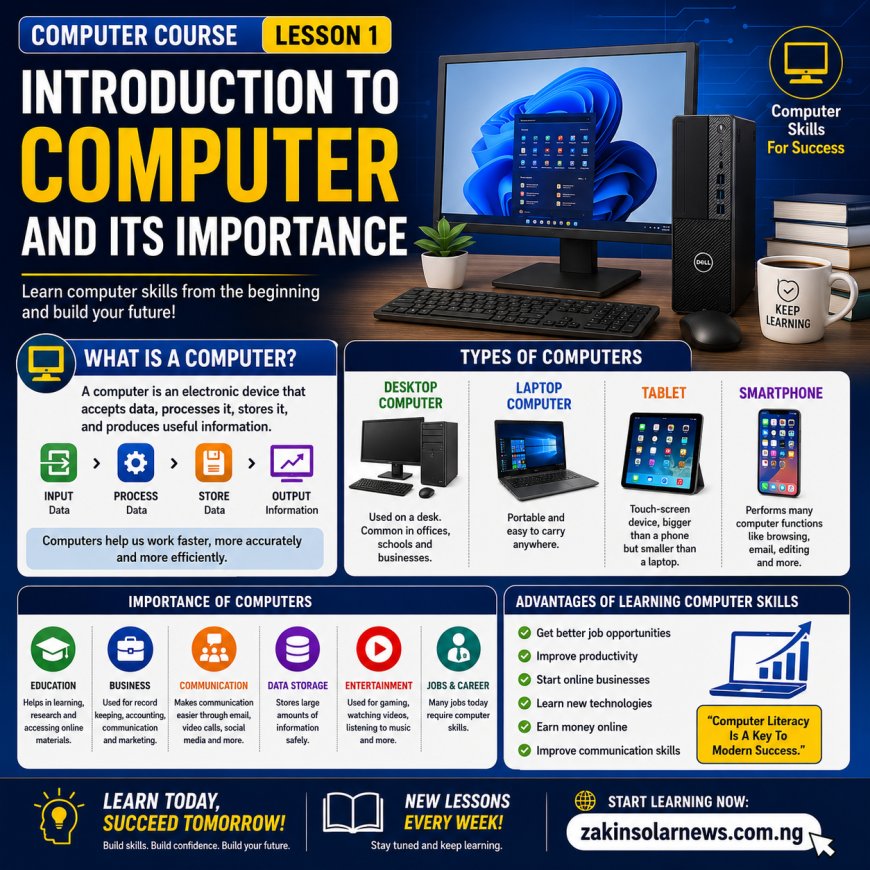
A computer is an electronic device that accepts data, processes it, stores it, and produces useful information.
In simple terms, a computer helps people perform tasks faster, more accurately, and more efficiently.
A computer can:
✔ Receive data (Input)
✔ Process data
✔ Store information
✔ Produce results (Output)
Types of Computers
1. Desktop Computer
A desktop computer is designed to be used on a desk or table.
It usually consists of:
Monitor
System Unit
Keyboard
Mouse
Desktop computers are commonly used in offices, schools, and businesses.
2. Laptop Computer
A laptop is a portable computer that can be carried anywhere.
Advantages of laptops include:
Easy to carry
Battery-powered
Suitable for students and professionals
3. Tablet Computer
A tablet is a touch-screen device that is larger than a smartphone but smaller than most laptops.
Examples include:
iPad
Samsung Galaxy Tab
4. Smartphone
Modern smartphones perform many computer functions such as:
Internet browsing
Email communication
Document editing
Online learning
Importance of Computers
1. Education
Computers help students learn, research, and access educational materials online.
2. Business
Businesses use computers for:
Record keeping
Accounting
Communication
Marketing
3. Communication
Computers make communication easier through:
Video calls
Social media
Messaging platforms
4. Data Storage
Computers can store large amounts of information safely.
5. Entertainment
People use computers for:
Watching videos
Listening to music
Playing games
6. Employment Opportunities
Many jobs today require computer skills.
Advantages of Learning Computer Skills
Learning computer skills can help you:
✔ Get better job opportunities
✔ Improve productivity
✔ Start online businesses
✔ Learn new technologies
✔ Earn money online
✔ Improve communication skills
Basic Computer Skills Everyone Should Learn
Every beginner should learn:
Typing skills
Internet browsing
Microsoft Word
Microsoft Excel
Email usage
Online communication
File management
These skills form the foundation of computer literacy.
Common Uses of Computers Today
Computers are used in:
Schools
Banks
Hospitals
Government offices
Businesses
Airports
Factories
Homes
This shows how important computers have become in modern life.
Conclusion
Computers are among the most important inventions in human history. They have transformed education, business, communication, and many other areas of life.
Learning computer skills can open doors to better opportunities, higher productivity, and personal growth.
Remember:
"Computer Literacy Is A Key To Modern Success."
Meaning: Computer knowledge is one of the most important skills needed to succeed in today's world.
Quiz Questions
What is a computer?
Mention four types of computers.
Why are computers important in education?
List five advantages of learning computer skills.
What are the four basic functions of a computer?
Mention five places where computers are commonly used.
Next Lesson:
Lesson 2: Computer Hardware and Software – Understanding the Main Components of a Computer.
What's Your Reaction?
 Like
0
Like
0
 Dislike
0
Dislike
0
 Love
0
Love
0
 Funny
0
Funny
0
 Angry
0
Angry
0
 Sad
0
Sad
0
 Wow
0
Wow
0